
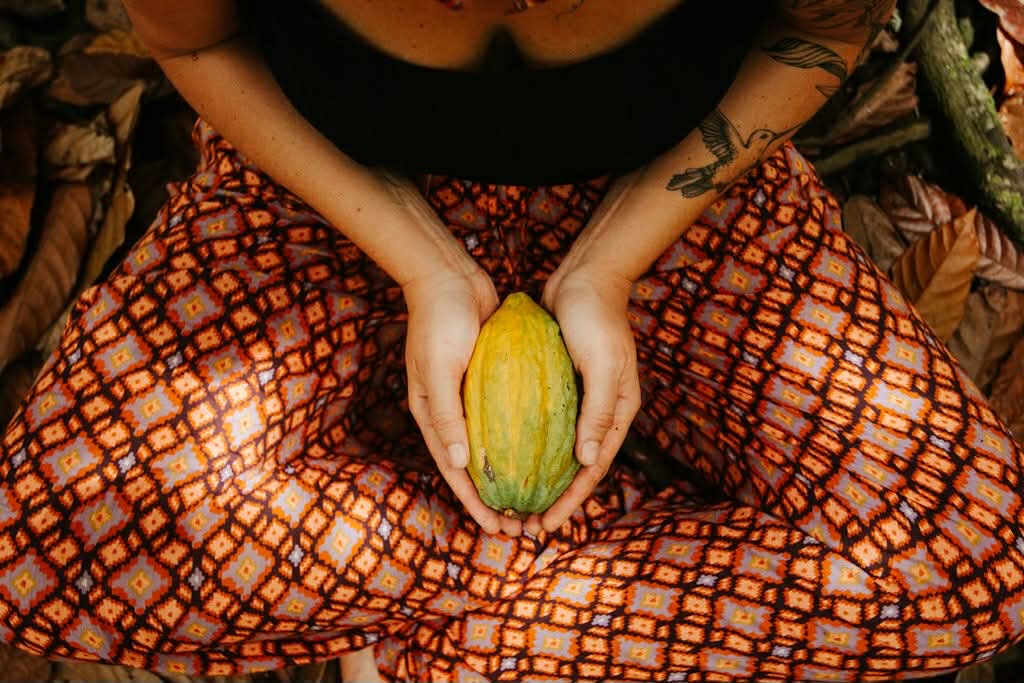
What Is Ancestral Cacao? The Truth Behind the Latest Cacao Label
Something interesting is happening in the cacao world.
As more questions are being asked about the term “ceremonial cacao”, I’m noticing another word appearing more and more frequently:
Ancestral.
Ancestral cacao.
Ancestral varieties.
Ancestral lineage.
Ancestral wisdom.
Ancestral farming practices.
And I have questions.
Not because ancestral knowledge isn’t real. It is.
Not because the ancient relationship between humans and cacao isn’t extraordinary. It absolutely is.
But because when a word carrying that much cultural and historical weight starts appearing on cacao packaging and in cacao marketing, I think we’re allowed to ask:
What exactly is ancestral cacao?
And perhaps more importantly:
Have we simply found another box to put cacao in?
What does “ancestral cacao” actually mean?
This is where things get murky.
There is no single universally recognised botanical or scientific classification called ancestral cacao.
So when a cacao brand uses the word ancestral, what exactly is it describing?
The genetics of the cacao tree?
The land it grows on?
The people growing it?
A farming practice?
A preparation method?
An unbroken cultural tradition?
Or simply the fact that the cacao happens to be grown somewhere in Central or South America?
These are not interchangeable things.
A community can hold ancestral knowledge about cacao.
A farming practice can have been passed through generations.
A particular place can have an ancient documented relationship with cacao.
A genetic population of cacao can have deep roots within a particular region.
But none of those things automatically tells us what is inside a modern bag of cacao.
And that distinction matters.
Where does cacao actually come from?
The relationship between humans and cacao goes back thousands of years.
For a long time, the popular cacao origin story centred heavily on Mesoamerica and the Maya and Aztec cultures. But archaeological and genetic research has made the history of cacao considerably more interesting.
The earliest archaeological evidence currently identified for the use of Theobroma cacao comes from the Santa Ana–La Florida site in what is now southeast Ecuador.
Researchers found cacao starch grains, theobromine residues and ancient cacao DNA dating back approximately 5,300 years.
Genetic research also points towards the Upper Amazon region of northwestern South America as an important centre of cacao’s genetic diversity and likely origin.
So yes, cacao has extraordinarily deep roots in the Americas.
And Indigenous cultures that developed relationships with cacao across South and Central America deserve to have those histories acknowledged rather than flattened into a modern wellness story.
But ancient cacao history and a modern product labelled “ancestral cacao” aren’t necessarily the same thing.
Cacao has been travelling for thousands of years
Here’s where the story becomes even more fascinating.
Humans have been moving cacao for a very long time.
Recent archaeogenomic research suggests cacao populations were being transported and exchanged across substantial areas of South and Central America thousands of years ago.
Different cacao populations encountered one another.
They mixed.
They hybridised.
Humans selected them, cultivated them and moved them again.
Even the beautifully simple story many of us were once told about the three cacao “varieties” - Criollo, Forastero and Trinitario - doesn’t adequately describe cacao’s genetic diversity.
A major genetic study involving 1,241 cacao accessions instead identified 10 major genetic clusters.
Cacao, it turns out, is gloriously promiscuous.
Nature wasn’t particularly interested in maintaining the tidy classifications we’d eventually create for her.
Is cacao from Central or South America more ancestral?
This is where I think we need to be careful with language.
Cacao certainly has a far deeper botanical and human history in the Americas than it does in places where humans introduced it much later.
That’s simply history.
But does cacao being grown in Peru, Ecuador, Guatemala or Mexico automatically make the cacao in a bag ancestral cacao?
Not necessarily.
Geography alone doesn’t tell us the genetics of those particular trees.
It doesn’t tell us when they were planted.
It doesn’t tell us whether the planting material has been introduced from somewhere else.
It doesn’t tell us whether the cacao has hybridised.
And it doesn’t necessarily tell us whether the people growing it today are maintaining an ancestral cacao practice.
Place matters. But place isn’t the whole story.
How did cacao reach Papua New Guinea and the Pacific?
Eventually, humans carried cacao far beyond the Americas.
Today Theobroma cacao grows throughout tropical regions of Africa, Asia and the Pacific.
Papua New Guinea is a fascinating example.
Cacao is not indigenous to PNG.
Historical records suggest cacao was introduced there around the late nineteenth and early twentieth centuries. Plant material arrived through several routes, including Samoa, Java and Ceylon, now Sri Lanka, with later introductions of Upper Amazonian material through Trinidad.
Over generations, cacao was selected, crossed and adapted to local growing conditions.
PNG subsequently developed its own cacao-growing industry, knowledge and relationship with this introduced plant.
So no, I would never claim that Papua New Guinea has the same several-thousand-year cacao history that parts of South and Central America have.
It doesn’t.
But here’s the question I find fascinating:
Did the cacao itself somehow lose its ancestry when it crossed an ocean?
Every cacao tree growing in Papua New Guinea ultimately belongs to the same species whose deeper evolutionary history leads us back to the Americas.
Its cultural history in Papua New Guinea is younger.
Its botanical ancestry isn’t.
Those are two very different conversations.
Does ancestral cacao mean better cacao?
This might be the most important question of all.
Sometimes words like ancestral, ancient, native and original begin carrying an unspoken suggestion:
Better.
More authentic.
More powerful.
More valuable.
More “real”.
But an ancient geographical relationship with cacao does not, by itself, tell us the quality of the cacao sitting in front of us today.
If I really want to understand a cacao, I want to know:
Where was it grown?
Who grew it?
What do we actually know about its genetics?
How was it harvested?
How were the cacao seeds fermented?
How were they dried?
How were they stored?
How fresh are they?
How were they roasted and processed?
How does the cacao actually taste?
Can the person selling it trace it back to the people who produced it?
And perhaps most importantly:
What did the farmer receive for growing it?
Those questions tell us an enormous amount about cacao.
The word ancestral printed across the front of a beautiful bag doesn’t necessarily answer any of them.
Ancestral cacao knowledge is real
This conversation needs nuance.
Questioning the term ancestral cacao does not mean dismissing ancestral knowledge.
Quite the opposite.
Cacao’s history deserves considerably more curiosity than it often receives.
Indigenous knowledge, traditional farming systems and living cacao traditions can represent generations, sometimes thousands of years, of observation, agriculture, adaptation, food culture and relationship with plants and land.
That deserves enormous respect.
But respecting ancestral knowledge and turning “ancestral” into a premium cacao product category are not necessarily the same thing.
I think we should be capable of holding both ideas at once.
Is ancestral cacao becoming the new ceremonial cacao?
I don’t know yet.
And I’m deliberately not going to pretend that I do.
But I’m watching the language change.
For years, “ceremonial cacao” became a way of separating certain cacao from ordinary cacao.
There is no universally recognised botanical or scientific standard defining a ceremonial grade of cacao, yet the term became incredibly powerful within the wellness industry.
Now, as more people begin questioning what ceremonial cacao actually means, I’m seeing ancestral cacao appearing more frequently in the conversation.
Perhaps that’s entirely appropriate in some cases.
But I think we should pay attention.
Because if ancestral becomes another undefined word used to imply purity, authenticity, potency, quality or superiority, have we really changed anything?
Or have we simply changed the label?
Do we really need another cacao hierarchy?
This is the bit I keep coming back to.
Do we really need another system for deciding which cacao is worthy?
Ancestral versus introduced.
Central and South American cacao versus African, Asian or Pacific cacao.
The deeper I go into cacao, the less interested I become in these hierarchies.
I’m much more interested in asking better questions.
Where was this cacao actually grown?
Who grew it?
How was it grown?
How was it fermented and processed?
How does it taste?
Can we trace it?
What was the farmer paid?
Those answers may be considerably less romantic than a beautiful word printed across a bag.
But they’re far more useful.
Maybe cacao doesn’t need another label
Maybe ancestral isn’t the problem.
Maybe our constant need to elevate one cacao above another is.
Cacao has travelled.
It has cross-pollinated.
It has adapted.
People have carried cacao seeds across forests, mountains, countries, continents and eventually oceans.
Different cultures have formed completely different relationships with this remarkable plant.
And that story is extraordinary enough without turning it into another hierarchy.
So when I see the words ancestral cacao, I’m going to keep asking questions.
Ancestral to whom?
Ancestral in what way?
Are we talking about genetics?
Geography?
Agriculture?
Culture?
Tradition?
And what does that word actually tell me about the cacao I’m about to eat or drink?
Because perhaps the next evolution in cacao isn’t finding a better word to put on the bag.
Perhaps it’s needing fewer of them.
Strip away the marketing. Strip away the hierarchy. Strip away the mythology.
What are we left with?
Cacao.
And cacao was already extraordinary.



Leave a comment
This site is protected by hCaptcha and the hCaptcha Privacy Policy and Terms of Service apply.